Space Laser Awareness

Menu

Laser Search

Spectroscopic Extraterrestrial Laser Search

“It would be appropriate to examine high-resolution stellar spectra for lines which are unusually narrow, at peculiar frequencies or varying in intensity.”

R.Schwartz and C.Townes 1961, Nature, 190, pg.205.

“Lasers can increase your data rate from Mars by 10 times over what you get from radio.”

Suzanne Dodd JPL Director of Interplanetary Network Directorate

“One great advantage of optical SETI is that there’s no terrestrial interference.”

Frank Drake

“Optical Inter-Satellite Links are the essential building block for next generation commercial and government space networks.”
Bulent Altan CEO Mynaric

Search for Laser Signals

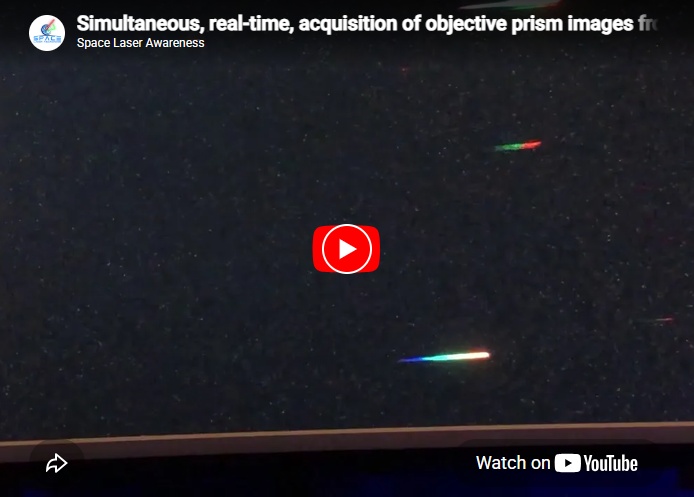
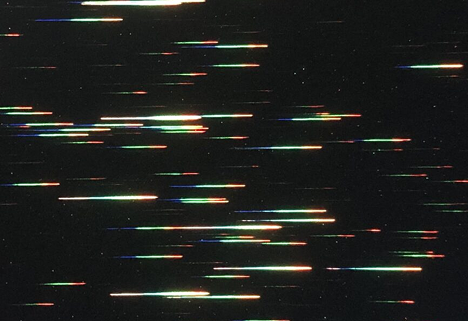
The Pleiades star cluster observed with the SLA objective prism telescope system. Each horizontal

The Pleiades star cluster observed with the SLA objective prism telescope system. Each horizontal streak is the spectrum of a star, including wavelengths 360nm to 1000 nm (left to right; blue to red). Laser emission would appear as a “dot” of one wavelength, validated by appearing in both telescopes at the same point in the sky and the same instant of time within 0.25 seconds.
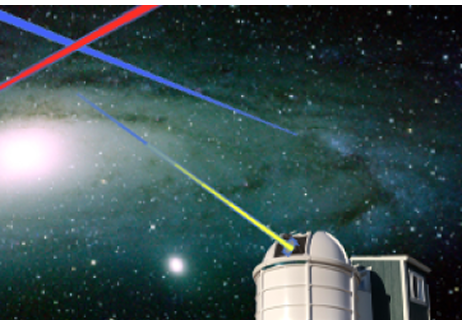
An artist rendering of communication lasers in the Milky Way Galaxy.
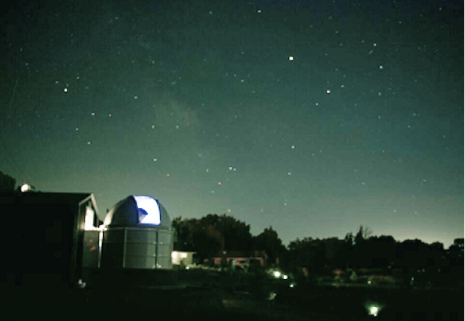
One field station of SLA, with Sagittarius (left), Scorpio (right). The two brightest objects are

One field station of SLA, with Sagittarius (left), Scorpio (right). The two brightest objects are Saturn (upper left) and Jupiter (upper right).

The Solar Gravitational Lens region of Alpha Centauri. Field of view is 2deg x 2.5 deg, in a 4 mi
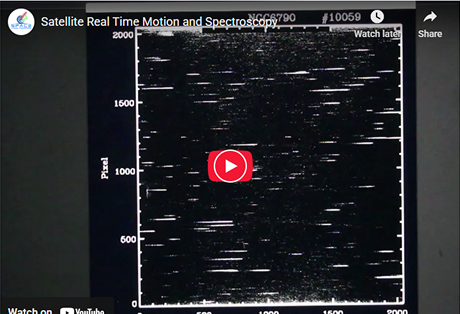
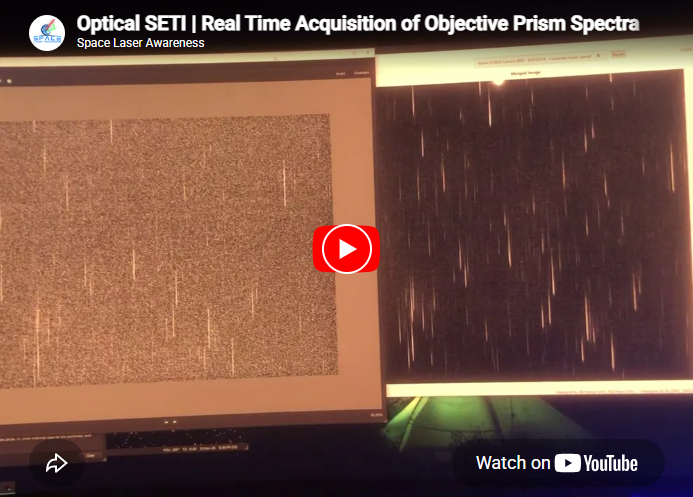
The Solar Gravitational Lens region of Alpha Centauri. Field of view is 2deg x 2.5 deg, in a 4 minute exposure with 0.28-meter objective prism Schmidt telescope. The hundreds of vertical streaks are stellar spectra. A laser will show as a PSF-shaped dot.

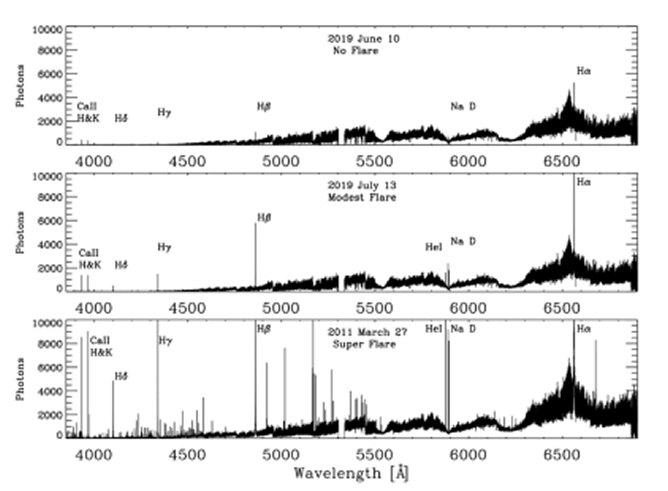
Proxima Centauri: A search for lasers.

Top: No flare. Middle: a medium-level flare. Bottom: a super-flare on Proxima Centauri.


Laser emission will appear as emission not associated with flares.  Spectra are courtesy of the
public ESO data archive.

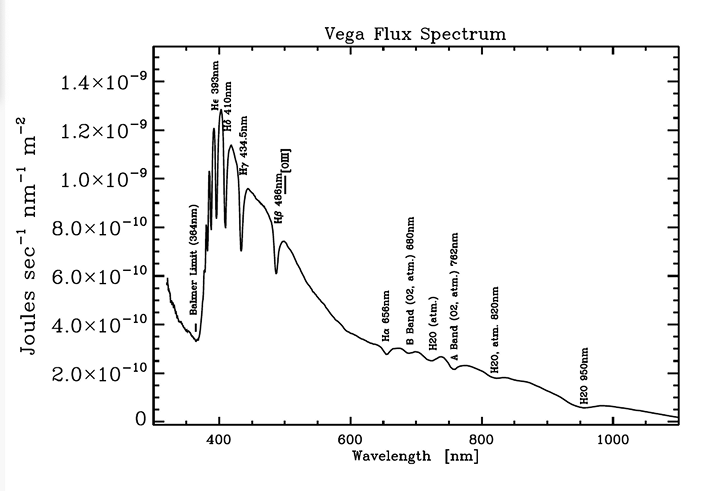
Vega Flux Spectrum

The observed flux of Vega vs wavelength, obtained with the Objective Prism Telescope, including Ultraviolet, Visible, and Near Infrared.

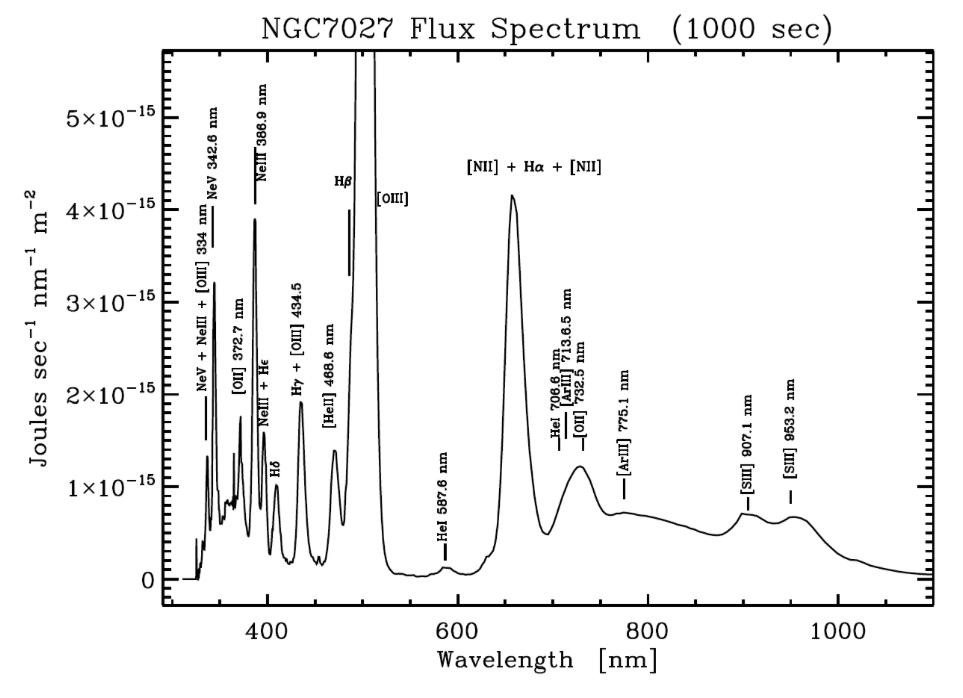
The spectrum of NGC 7027

The flux spectrum of the planetary nebula, NGC 7027, vs. wavelength, observed with the Objective Prism Telescope. Emission lines are detected from wavelengths 334 nm to 952 nm, with sensitivity just beyond 1100nm.

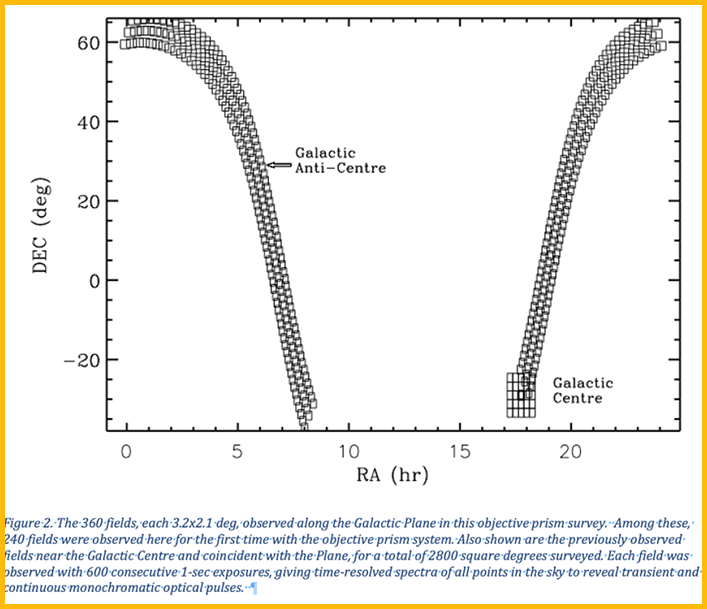
Galactic Plane in this objective prism Survey

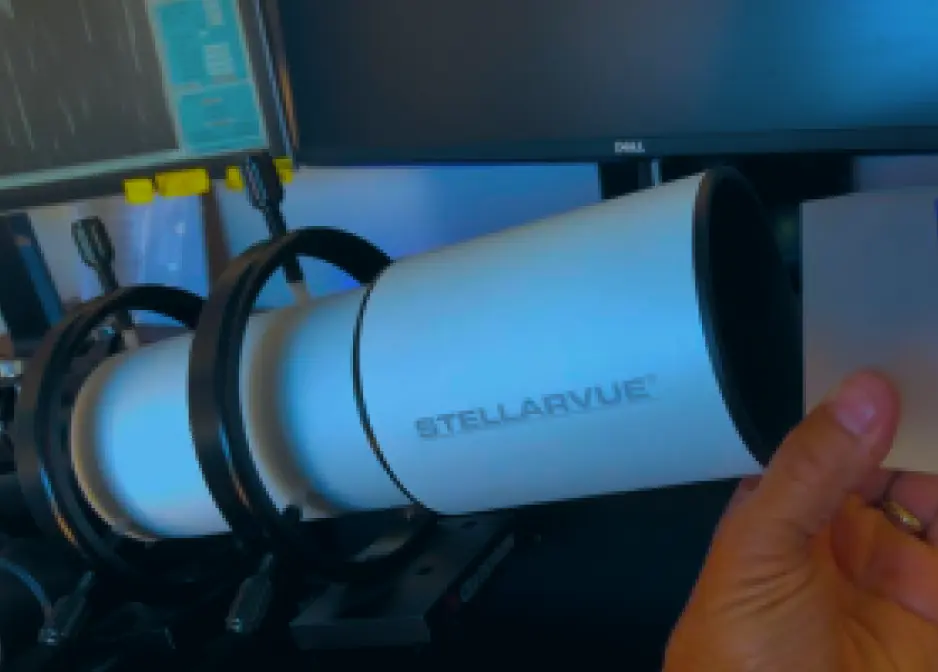
Our optical systems are particularly sensitive to laser communication, easily distinguished from continuous spectra produced by asteroids, planets, stars, and other astrophysical sources. Simultaneous observations with a second telescope provide confirmation.