Space Laser Awareness

Menu

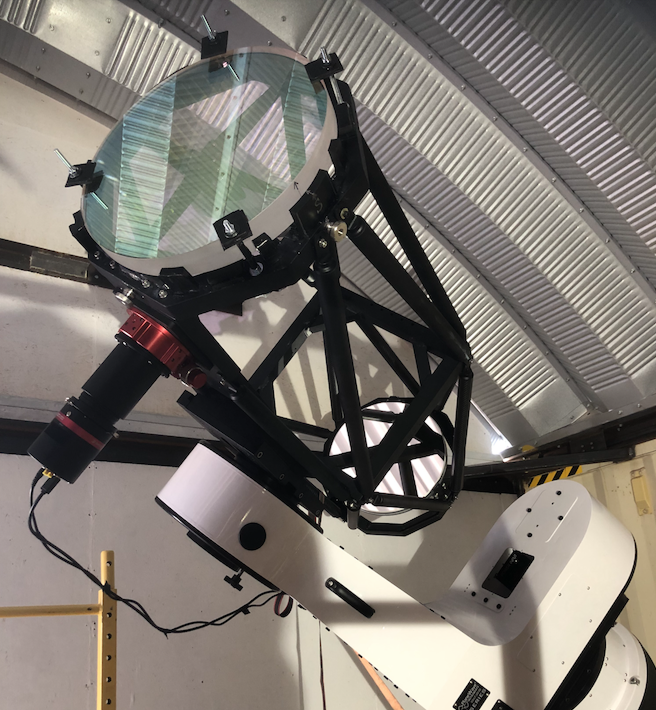
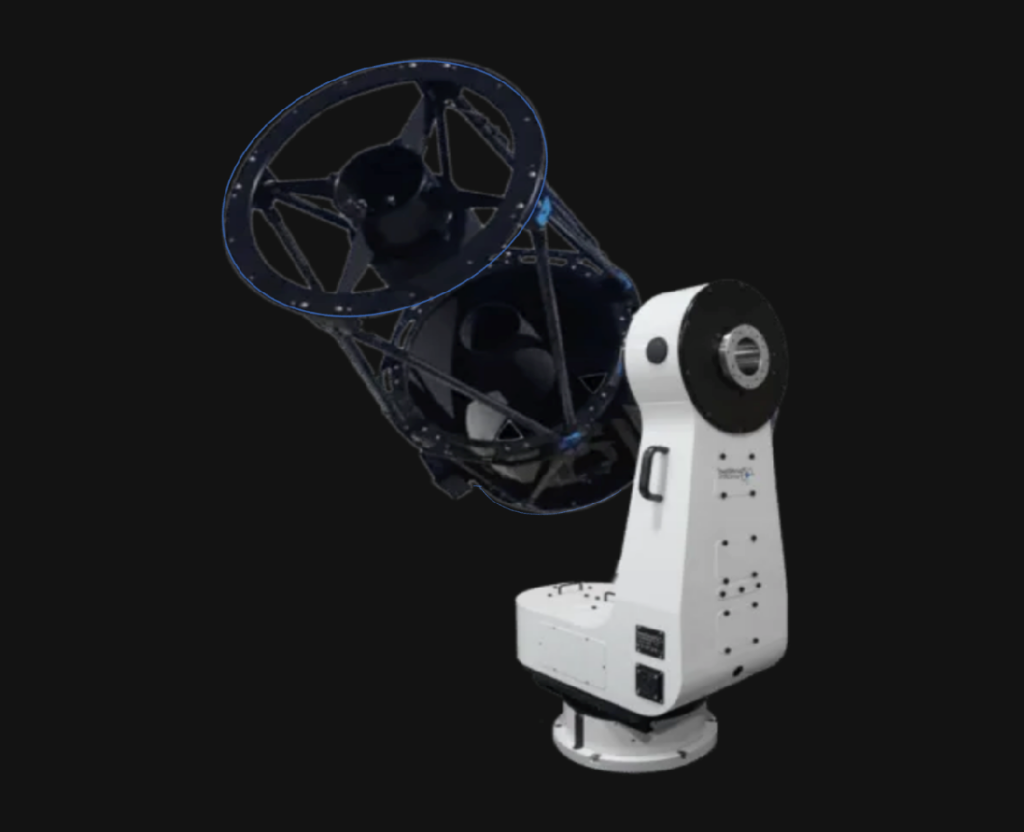
CDK20 0.5-meter + UVEX Spectrometer

Telescope:

- CDK20 Aperture: 0.5-meter
- f-ratio f/7.77 (and f = 3951mm) matches needed f-ratio of UVEX spectrometer
- Standard coatings on CDK20 on M1, M2, and lens group: Throughput > 80% at 380 - 900 nm.
- PlaneWave IRF90 Rotator-Focuser
- 50 micron slit ==>

Spectrometer:

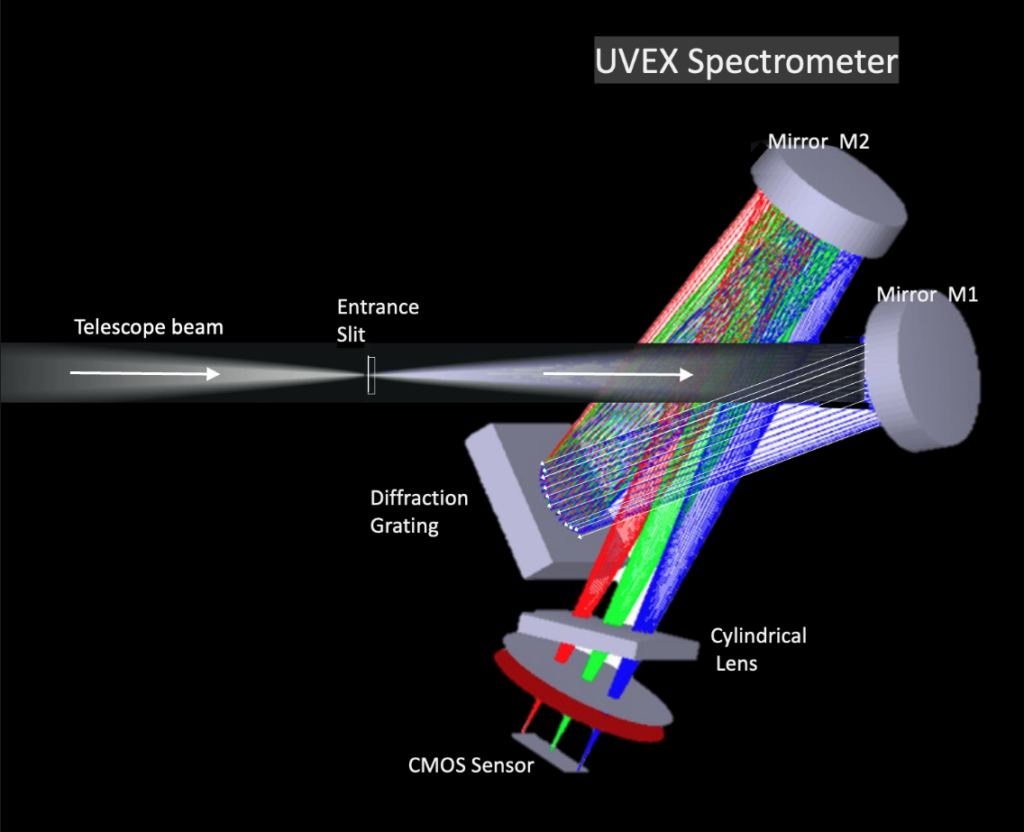
- UVEX from Shelyak with 50 micron slit:
Grating - 600 l/mm: Dispersion = 15.5 nm/mm, Span = 300 nm, Resolution = 0.78 nm
Grating - 150 l/mm: Dispersion = 62 nm/mm, Span =1200 nm, Resolution = 3.1 nm

- Slit: 50 microns (2.6 arcsec); No guiding needed for 10 min.

- Focus is stable (no need for motorized focusing)
- Guiding Module from Shellac
- Guide camera ASI174 Mini (from Shelyak)

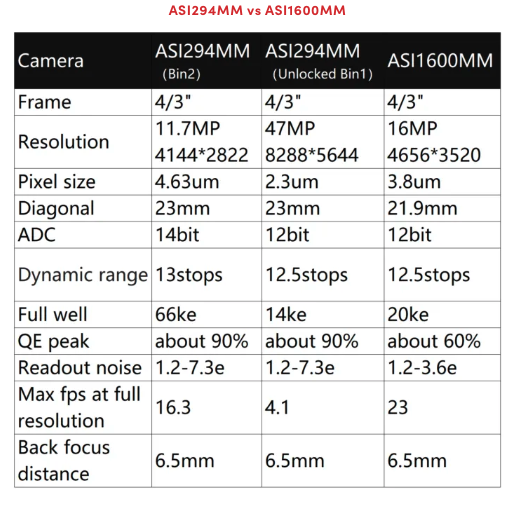
- Main Camera: ASI294MM                               “Bin2 mode” has 4.63 mu pixels, read noise (Bin2) = 1.3 e-, size = 19.2 x 13 mm

Read noise in a Resolution Element:

A resolution element on the sensor is 50 x 50 mu (2.5” x 2.5”) = 2500 mu^2


Area of one pixel = 4.63mu^2 = 21.4 mu^2

==> # Pixels in a Resolution Element = 2500 mu^2 / 21.4 mu^2 = 117 pixels

==> Read Noise per Resolution Element = 1.3e- x sqrt(N_pixels) = 1.3 x SQRT(117) = 14 e- (RMS, per resolution element.)


Read noise is comparable to the sky noise and object’s Poisson noise at 18 mag.


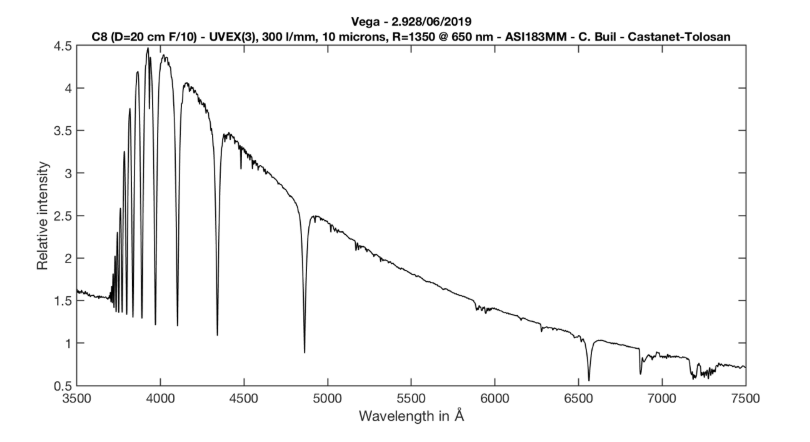
This spectrum of Vega was obtained with the grating ruling, 300 l/mm, but a narrower slit of 10 microns.

Noise Budget at 18th magnitude (Poisson, Sky, Read)

1. Parameters:
Telescope Collecting Area: 0.5m and 39% central obstrcution ==> Collecting Area, A = 0.166 m^2
Throughput (telescope optics,slit,spectrograph,QE of sensor) = 0.21
R = 200 at H-alpha ==> Resolution delta Lambda = 3.3 nm
Seeing = 2.5”
Sky Brightness = 21.3 mag/arcsec^2


2. Consider 18th magnitude. Calculate the SNR from a 20-minute exposure.
Using AB-magnitude scaling at 656.3 nm, an 18th-mag continuum gives roughly:
We will Detect ≈ 0.61 photons/s per 3.3 nm resolution element

In 1200 s: 730 photo-electrons


3. Sky background (21.3 mag/arcsec^2) in extracted 1D spectrum

Extract spectrum in resolution element, 5” x 5” = 25 sq. arcsec.==> Sky contribution is 25x brighter than 21.3 mag/arcsec^2 ==> equiv. to 18th mag star==> Sky photons and star photons enter the slit at the same rate!

The Number of Sky photons is comparable to the Number of Star Photons in the extracted spectrum.


4. Read noise in extracted 1D spectrum
5” x 5” = 100 mu x 100 mu ==> (100 mu / 4.63 mu/pixel)^2 = 467 pixelsTotal read noise in 5”x5" = 1.3 e- / pixel * sqrt(467) = 28 e- (rms)


5. Total Continuum SNR in Subexposure of 1200 sec:
SNR = S / SQRT(S + Sky + Read^2)
= 730 / sqrt(730 + 730 + 28^2)
= 15 per 100 mu (3 nm) resolution element


Conclusion
The 0.5-m CDK and UVEX spectrometer + ASI294MM
is able to take spectra of 18th mag objects in 20 minutes, yielding SNR = 15.
spectroscopy-of-transients

The Spectroscopic Telescope

The Spectroscopic Telescope is specifically designed to detect transients in the night sky with unusual spectra, including ultraviolet emission. The system features either a wedge prism mounted in front of the telescope or a UVEX spectrometer mounted at the focus of the telescope, both using a large CMOS camera sensitive to UV, optical, and near-infrared light, and a frame-rate of 10 frames per second.


These spectroscopic telescopes obtain spectra of unusual transient sources, including astrophysical and spacecraft.

The UV-Optical-IR Wide-field Objective Prism Telescope

UV-Optical-IR Wide-field Prism Telescope

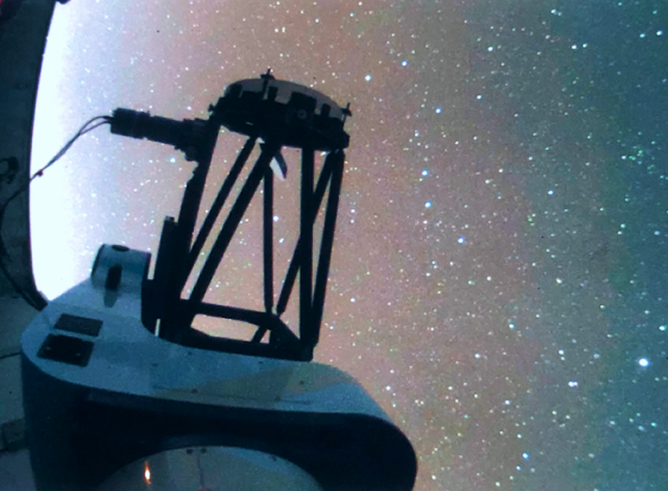
The UV-Optical-IR Wide-field Objective Prism Telescope, operating in southern New Mexico.

It takes spectra of every source within a 1-degree field-of-view at 10 frames per second.

 1-degree field-of-view

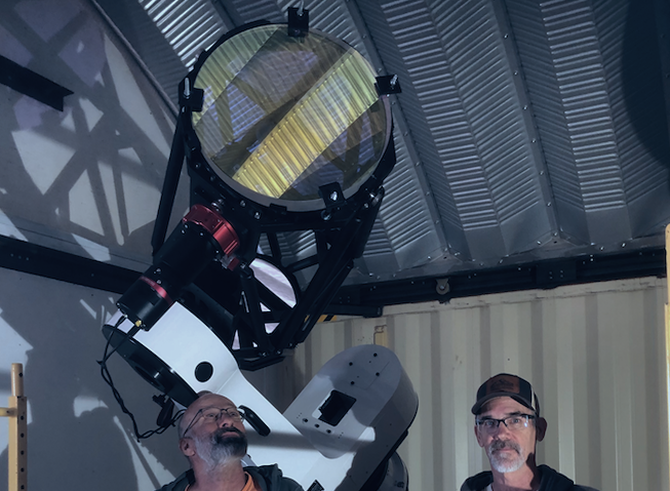
The UV-Optical-IR Wide-field Objective Prism Telescope. It provides a 1-degree field-of-view and 10 frames per second. Constructed by Brian Hill (left), John Adler (right), and the Space Laser Awareness team.

Fast CMOS camera is designed 

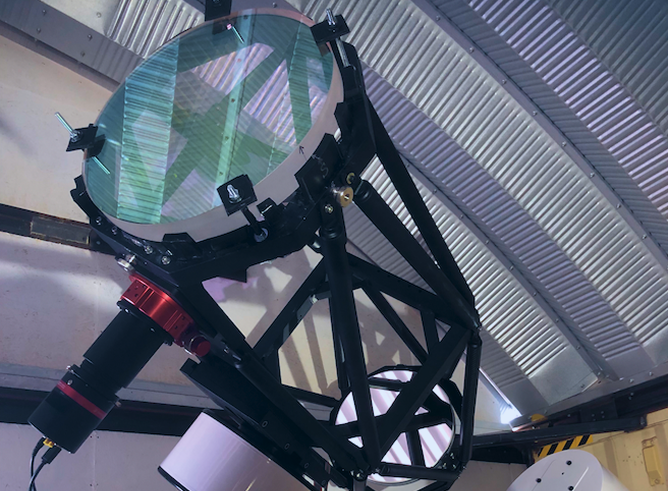
A close-up of the large wedge prism at the front of the UV-Optical-IR Wide-field Objective Prism Telescope.

Its 1 degree field of view and fast CMOS camera is designed to search for transients having unusual spectra.

Covering wavelengths from 320 to 950 nm

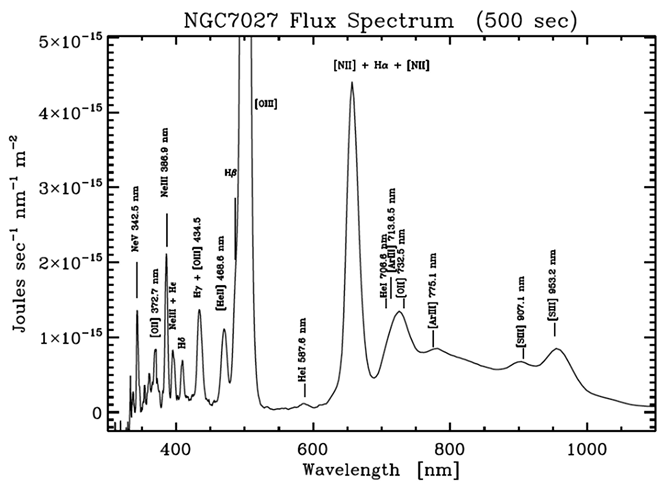
Here is a representative spectrum from the Objective Prism Telescope in New Mexico, covering wavelengths from 320 to 950 nm. Every point within a 1-degree field of view produces spectra with this level of resolution.

UV-Sensitive Objective Prism Telescope.

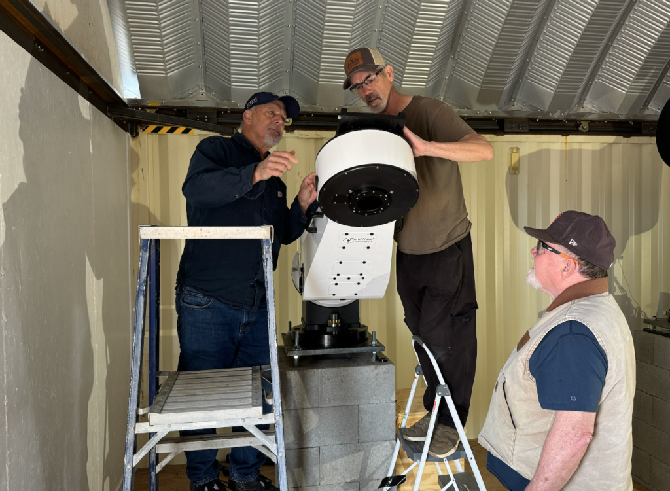
Geoff, John, and Michael (left to right) constructing and deploying the PlaneWave mount for the UV-Sensitive Objective Prism Telescope.